BibTex is a program that reads entries from a database of citationsbased on the output of LATEX andthen makes a bibliography file thatLATEX can insert into thedocument. There is lots to say about BibTex (and some good manuals that doit well) but here are some essentials I have found useful and not coveredin the books. (There is a lot to say and learn about LATEX too).
Run Apple's Terminal application in /Applications/Utilities. Openssl md5 and add a space at the end. Then drag and drop the file MacTeX.pkgto the Terminal window to complete the command. Bibtex mac free download. BibDesk BibDesk is a graphical bibTeX bibliography manager for Mac OS X. BibTeX & Mac OS X. BibDesk A graphical BibTeX-bibliography manager; BibTeX & MS Word. Bibshare Very handy framework to use BibTeX with different word processors; BibTeX Styles. BibTeX Style Examples See the results of different styles; Alternatives to BibTeX. Biblatex A complete reimplementation of the bibliographic facilities provided by LaTeX.
Finding the material for a BibTex database is a chapter of itsown, covered at least briefly at http://www.sci.utah.edu/~macleod/litbase
There is a repository ofbibtex files available for use at the SCI Institute.
Quick Links:
There are a suggestions when using BibTex:
- The standard way to show citations in the text is as ``[N]' where N is the reference number in the bibliography. We often use a style and a package called as usepackage[super]{cite} in the LaTeX file that writes them as superscripted numbers. This style is also smart enough to find sequences of numbers and compress them, e.g., text1,2,3,4,5,9 becomes text1-5,9.
- Enter refs as you go and do not leave them all to the last minute! This makes for unnecessary stress when we need it least. Give us your refs in whatever form you have and we can get them entered now.
- If you are part of SCI (or otherwise smart and organized), please note the key naming conventions we use. You can find these in the SCI Bibtex tips web page.
The default location for the Bibtex files for a document are in the samedirectory as that document. A slightly better solution is to have adirectory that holds all your Bibtex files and then hard-wire the commandsin LateX to find those files.
A better way (the best way?) is to store all your Bibtex files in oneplace in your computer, ideally managed through a system like Subversion,and then to tell the Bibtex program where to look. How this works dependson the operating system and the Bibtex application, of course, but here aresome typical examples. I found a lot of this information at this web site by Julien Dutant .
- Unix, in all its flavors.
This is the simplest but not the most common, sadly. The solution requires, of course, on an Environmental variable, which users typically set in a start script like .bashrc (for the Bash shell). This bit of code also sets the TEXINPUTS environment variable, which is also helpful when one has some style files that are stored in a common directory and need to be available to all LaTeX files. ${HOME} is a built in variable that is set to be a user's home directory so this bit of code sets my LaTeX directory to ~macleod/tex/latex and my Bibtex directory to ~macleod/litbase/bibtex. - TexShop on the Mac (OSX)
TexShop is based on TexLive and TeXLive requires a pre-set location, i.e., you cannot adjust this location and must store all .bib files in this place. The files go in
or subfolders of this directory.Of course, this directory is not directly visible in the modern versions of Mac OSX and the Finder, thus protecting users from all this tedious detail? To access the ~/Library directory, either use a terminal or use the 'Go' command in the Finder but hold down the the option key to see this directory in the list. Here is what the result should look like:
Once visible, you can maneuver to the texmf/ directory and then add the necessary bibtex/bib directories and store bibtex files there.
I like to keep things in the same (visible) place for all programs that use bibtex so I have created a link between this standard location and the place TexShop wants to see things. This is a Terminal command so use with the usual care: You should then see something like the following (again from a terminal window): A above, this assumes my bibtex files are all in my directory.
- WinEdt
In the control menu: Menu > Options > Executions Modes...
A window opens with several tabs. In the 'Console Applications' tab, you find a list of commands. Select bibtex, and add to the 'Switches' field:
NIH requires public disclosure of journal articles supported by NIHfunding and all such articles receive a code called the PMCID as part ofthe PubMed system. As an NIH funded researcher, you MUST include this codeevery time you cite such a reference, especially in progress reports,proposals, and biosketches.
To support this code in BibTeX, I have created a slightly modifiedversion of one of the most common BibTeX style files (.bst), which isavailable here.
To use this new style file,
- Add a field called 'pmcid' to each BibTeX reference that contains the PMCID string, which you can locate by searching for the papers in the PubMed system.
- Modify your bibiographystyle command to look (something) like this:
To edit a BibTex file, you can use any editor but emacs has lots ofgreat support for this process. The ones I like are Nelson Beebe's emacstools found at www.math.utah.edu/pub/emacs/, in particular bibtoolsand bibtex-support.
Here is what my .emacs contains to access these:
Note that these commands assume a subdirectory called emacs/lispin which the require lisp code (.el or .elc files) isavailable.
There are some other fun software tools that can make life easier withBibTex. Most are in the public domain in one form or another and I haveincluded links where I had them--if the links fail, use Google and pleaselet me know (macleod@sci.utah.edu).
5.1 EndNote
EndNote is notreally a program that works on BibTexfiles but it does manage citationswell and it has some support for BibTex that can make it useful.
See endnote.html for moredetails on how to convert between Endnote and BibTex.
5.2 bibclean
The goal of bibclean is to clean up syntax and layout errors in BibTexfiles so that all entries have a nice, clean look that is consistent. Theprogram will also reveal some errors in the file, which can be veryhelpful! To get bibclean, surf on over to
www.math.utah.edu/pub/bibclean/and thank Nelson Beebe for making this available.
Here are some direct links that might be helpful
- Initialization file for bibclean, keep this somewhere that bibclean can find it.
One of the many arguments to bibclean essential for SCI databases, ifonly because it is the convention we had adopted:which I actually alias to bibclean so that I don't forget!
5.3 Mendeley
The free literature databased program Meddeley has support for Bibtex output.
5.4 Converting from Word bibliography to BibTex
This is truly amazing! There is a website called hubmed.orgthat will convert from Word document text that you copy to the web pageinto Bibtex files! It actually works.
This program is some sort of search engine interface to Pubmed and itmanages to parse the text and propose matches for each entry in thebibliography. I am really impressed with this tool!
5.5 Testing a BibTex file
There is a simple way to test a BibTex file for completeness usingLATEX and the bibtex commands fromyour own computer. Testing is a good plan, especially if you do it afterediting the file and not when you are in a hurry and have to build adocument using the file.
To test a BibTex file, make a LaTeX file, call it testbib.texwith the following contents:where ``sci' is the name of the BibTex file to test.
Then runand the output will list all the errors or warnings resulting from tryingto parse the file sci.bib. Some of the output will be warningsthat you can ignore but other errors can be fatal the next time you use thefile.
5.5 BibDesk
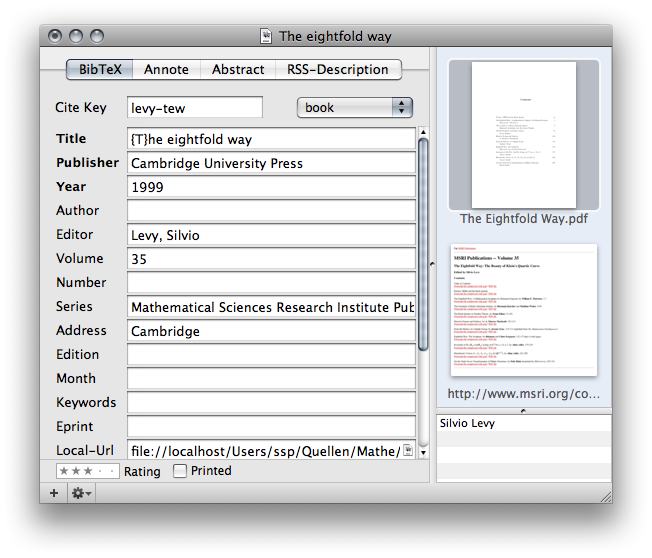
BibDesk is a Mac OSX program to edit and manage your bibliography. It willkeep track of both the bibliographic information and the associated filesor web links for you. Read more atbibdesk.sourceforge.net/.
5.6 JabRef
JabRef is a new cross platform,open source program to edit and manage your bibliography. It performssearches and downloads articles (assuming they are open access) and seemsto have a lot of customlization options. It claims to integrate well withmany LaTeX systems/editors, including eXstudio, LyX, Kile, LatexEditor,Emacs, Vim, and WinEdt.